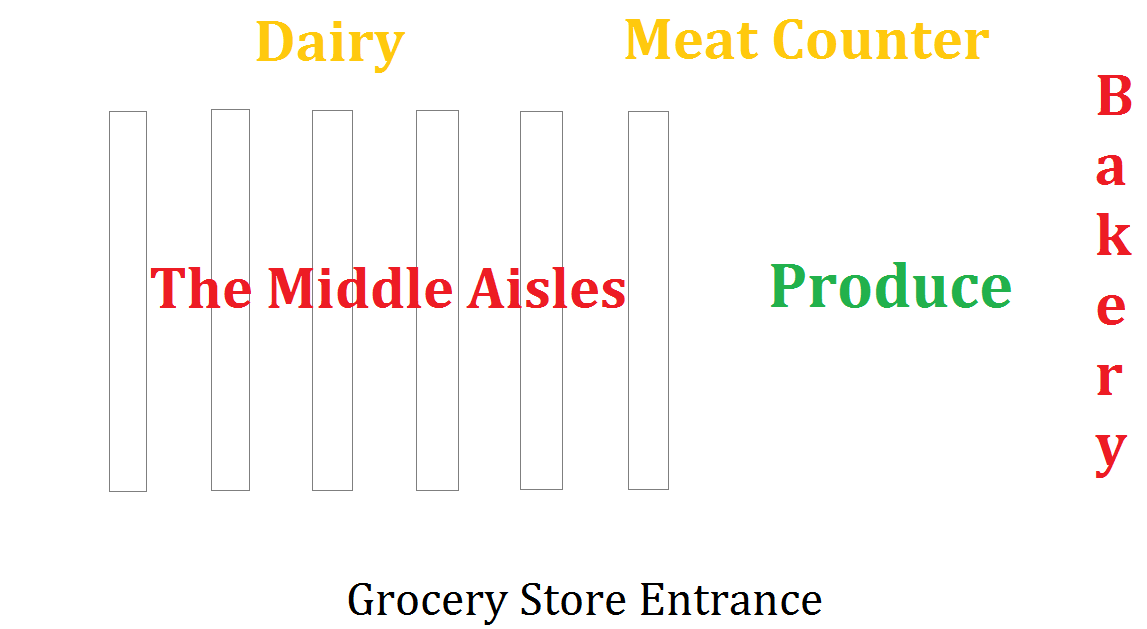
A healthy lifestyle goes hand in hand with a well-balanced diet, which begins with smart grocery shopping. Now, the grocery store can be more overwhelming than the information contained here, but this is a great place to start, especially if eating healthy is new to you. The grocery store is a huge place full of misleading labels, but here are a few key guidelines to help you shop smart. Most importantly, shop the perimeter of the store. The perimeter is where you’ll find the fruits, vegetables, lean proteins, and low fat dairy products, all of which are the foundation of a well-balanced diet.
Green– GO! These sections are mostly a free for all (with some loose guidelines)
Yellow– Proceed with caution, following a few simple guidelines
Red- Be sure you’re armed with good information to make the better choice
PRODUCE:
What to Look For:
Vegetables – The greens should be your first choice when looking for vegetables, such as broccoli, asparagus, spinach, green beans, and kale. Your second choice should be red and orange such as red peppers and carrots. Vegetables should be incorporated at every meal to receive their vital nutrients. You can never have too many vegetables.
Fruit – Berries are full of antioxidants and a variety of nutrients, making them the best choice when picking out fruit. The second best would be citrus fruits such as oranges and grapefruit, followed by bananas and melons. Bananas and melons are third on the list because of their high glycemic index, meaning they raise your blood glucose (sugar) levels more than berries.
Sweet Potatoes- These are a better choice due to the lower glycemic index, compared to white. Just like berries are a better choice over melons, sweet potatoes are a better choice over white potatoes. Add a little flavor with cinnamon, but please do not cover the sweet potatoes with marshmallows!
What to Avoid:
You really can’t go wrong in the produce department because fruits and vegetables are going to be better than any other options. For example, even though berries are preferred over bananas, if you’re making a decision between a banana and a granola bar for a snack, the banana is clearly the better option. To start, shoot for 5 servings of fruits and vegetables each day.
MEAT COUNTER:
What to Look For:
Chicken- This is going to be one of your best options when looking for a lean meat, but be sure you’re eating the white meat. Grill it or bake it and please do not cover it with a bunch of breading!
Loin=Lean- Look for the word loin, because it is one of the leanest cuts of meat. Pork loin, sirloin, and tenderloin are all better choices. Lean red meats in moderation provide a great source of protein, B-vitamins, iron, and zinc, which help to provide energy and a healthy nervous system.
What to Avoid:
Pre-Seasoned Meats- The mesquite barbecue pork loin and sun dried tomato chicken breasts always look delicious, but get creative with your meats and spice ‘em up in your own kitchen. Pre-seasoned meats are typically high in sodium, so when you spice it up yourself, you control what goes on it and therefore, what goes in your body.
Anything Breaded- Added extras like this are trouble because you end up consuming “empty calories.” Buy meats in their natural state and add your own seasonings.
DAIRY:
What to Look For:
Plain Greek Yogurt- this is the best option in the dairy department, because Greek yogurt is higher in protein and buying plain spares the extra sugar that other flavored yogurts are loaded with. My favorite way to eat Greek yogurt is to add natural peanut butter, honey, and some banana. Throw it in the freezer for an ‘ice cream’ treat!
What to Avoid:
Fat-Free- Fat gives food flavor, so when it is removed, sugar must be added to keep the flavor. Avoiding a bunch of added sugar is a must! It would be better to buy normal, full fat options to consume less sugar.
THE MIDDLE AISLES:
This is the toughest part of the grocery store to maneuver, I could go on for days about what is bad, good, the worst choice, the somewhat better choice, and why, but I’ll save that for another time. So, without going into a completely separate discussion on how to read a food label, here are the key things to look for and the top 2 words to avoid.
What to Look For:
Frozen Fruit & Vegetables- Frozen is a great alternative to fresh because it retains the nutrients. Frozen berries go great in smoothies and oatmeal, while frozen vegetables are convenient and nutritious.
Natural Nuts- Almonds, pistachios, and cashews are a great mid-day snack and provide Omega 3 and Omega 6 fatty acids.
Oatmeal- In this order, steal cut, old fashioned, and quick oats are great options for breakfast. Steal cut oats are the least processed, with quick oats being the most processed. Avoid the pre-packaged oatmeal that tend to be loaded with sugar. Instead, add frozen blueberries, strawberries, cinnamon, or natural peanut butter to flavor your oats.
Whole Grains- When buying bread this is the key word and should be listed first. If it is not listed first, put the bread back on the shelf. Quinoa, brown rice, and whole grain pasta are other better choices to balance your diet with complex carbohydrates.
What 2 Words to Avoid:
“Enriched” and “Refined”- When looking at anything in the middle aisles, cereals, breads, granola bars, frozen meals, and pastas, turn the package over and look straight at the ingredients list. If you see “enriched” or “refined,” put it back on the shelf. Following these two words you’ll likely find “sugar.” Real whole grains are loaded with fiber, which has a variety of healthy benefits. Fiber is the key to a healthy digestive system and can also help lower cholesterol and decrease the risk of heart disease.
Happy Shopping!
Coach Cota
 @THECOACHCOTA
Pingback: Sports Nutrition Literacy | Coach Cota